Mrs. Vinton's field
Mrs. Vinton's field is the broad, grassy meadow that lies directly behind the Creed house in Ludlow, separating the family's manicured lawn from the dense woods that climb toward the Pet Sematary and, beyond it, the Micmac burying ground. It is a place of deceptive tranquility, a pastoral landscape that initially seems to offer only the wholesome pleasures of rural life—a space for children to play, for a kite to soar—yet its very proximity to the forest makes it the final boundary between the ordinary world and the encroaching darkness. The field is owned by an elderly, frail woman named Mrs. Vinton, who lives in a brick house at its head and rarely emerges, lending the space a sense of quiet, almost forgotten ownership.
The Last Happy Day: The Kite Flying
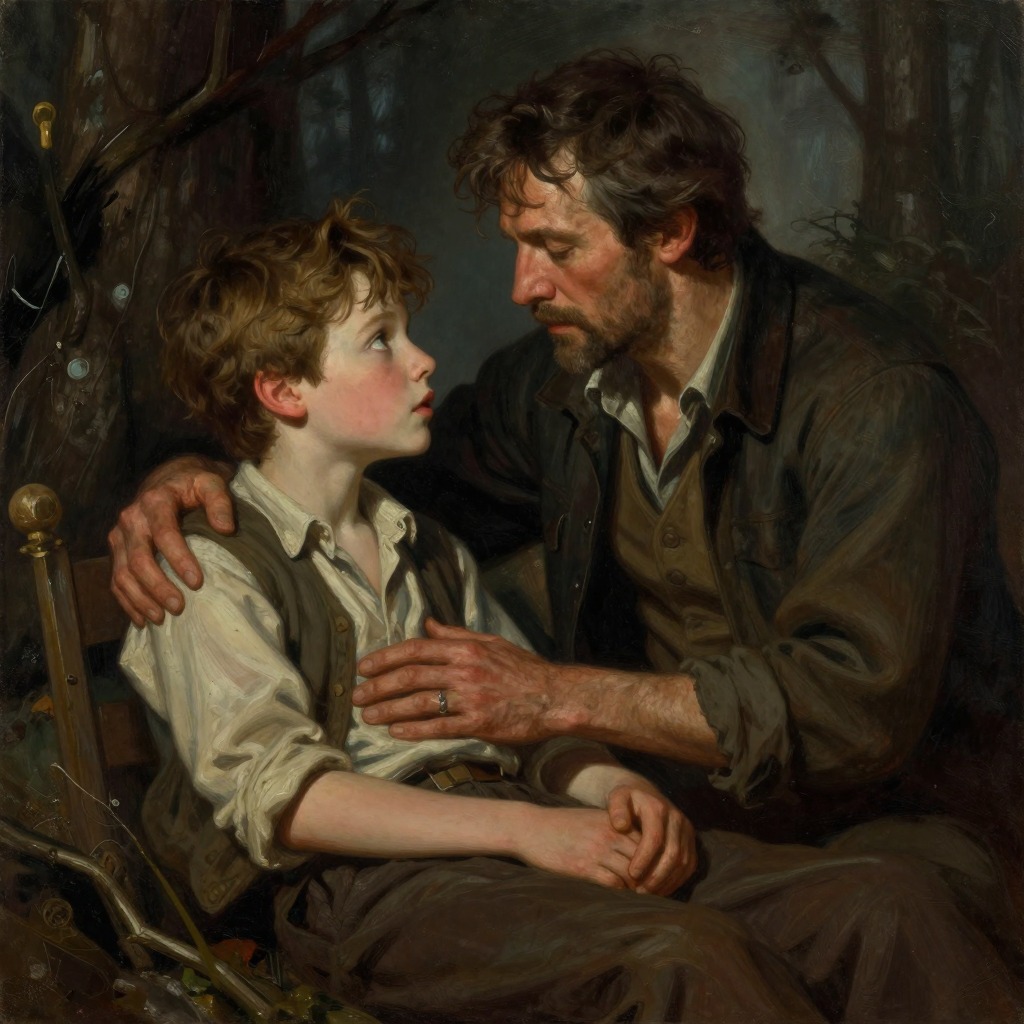
The field is most memorably the setting for the last genuinely happy day of Louis Creed's life, March 24, 1984. On that Saturday afternoon, while Rachel and Ellie were grocery shopping with Jud Crandall, Louis took his son Gage out to Mrs. Vinton's field to fly a kite—a large, black plastic Vulture with bulging, bloodshot eyes that he had bought on a whim during the depths of the previous February. Louis got the kite into the blowy late-March sky on his first attempt, and the two of them stood together in the high, dead grass, the wind tumbling their hair, as the Vulture soared higher and higher. Louis wound the string around Gage's small hand, and the boy, laughing shrilly and joyously, cried out, "Kite flyne, Daddy!" In that moment, Louis felt himself shrink and enter his son's consciousness, seeing the world through Gage's eyes—a world where the field was as vast as the Bonneville Salt Flats and the kite drummed in his fist like a live thing. This shared experience of pure, uncomplicated joy, with the Vulture's shadow tracking across the white late-winter grass, became a memory Louis would cling to as the nightmare unfolded.
A Threshold Between Worlds
Beyond its role as a playground, Mrs. Vinton's field functions as a crucial liminal space in the novel's geography. It is the last open, sunlit area before the woods begin—the woods that contain the path to the Pet Sematary and, beyond the deadfall, the Micmac burying ground. The field itself is bounded by rock walls on two sides and by Route 15 at its bottom, a road that Jud Crandall had warned the Creeds about on their very first day in Ludlow, calling it "one mean road" that "uses up a lot of animals." The field thus sits at the intersection of domestic safety, the deadly highway, and the wild, supernatural forest. It is a place where the ordinary rules of the world still apply, but from which one can see the path that leads to the extraordinary and the terrible. The Vulture kite, with its predatory name and appearance, seems to preside over this threshold, its shadow a dark omen that Louis, in his happiness, does not recognize.
Narrative and Thematic Significance
Mrs. Vinton's field is never the site of horror itself; its power lies in its contrast to the horror. It represents the life that Louis and his family could have had—a life of kite-flying, of simple pleasures, of a future in which Gage grows up to win Olympic medals. The field is the stage for the novel's most poignant moment of paternal love, a moment that Louis later recalls with aching clarity as he descends into madness. The field's very ordinariness makes the subsequent tragedy more devastating: it is from this same field that Gage, just weeks later, will run toward Route 15 and his death. The field, then, is a place of memory and loss, a pastoral idyll that the narrative revisits only in the mind of a grieving father. It is the last outpost of the normal world before the story plunges irrevocably into the dark woods, and its green, open expanse becomes a symbol of everything that the Micmac burying ground—with its stony soil and its power to resurrect the dead—will ultimately corrupt and destroy.